
Today, we’re talking about harmony, and you’re going to learn how to play the D6 chord on guitar and the theory behind it.
So, if you’ve ever seen “D6” in a chord chart and want to understand how it works, then this lesson is for you.
Table of Contents
What is a D6 chord on guitar?
You can think of a D6 chord as a D major triad with an added 6th interval.
This gives you the root note “D“, the major 3rd “F#“, the perfect 5th “A“, and the major 6th “B“.
So, if you already know the D major chord, add the 6th (B) to turn it into D6, which has a relatively jazzy sound.
- Notes in the D6 chord: D-F#-A-B
- Major 6th chord formula: 1-3-5-6
How to play the D6 chord on guitar (Easy Shapes)
Now, let’s look at some common and easy ways to play D6 on the guitar.
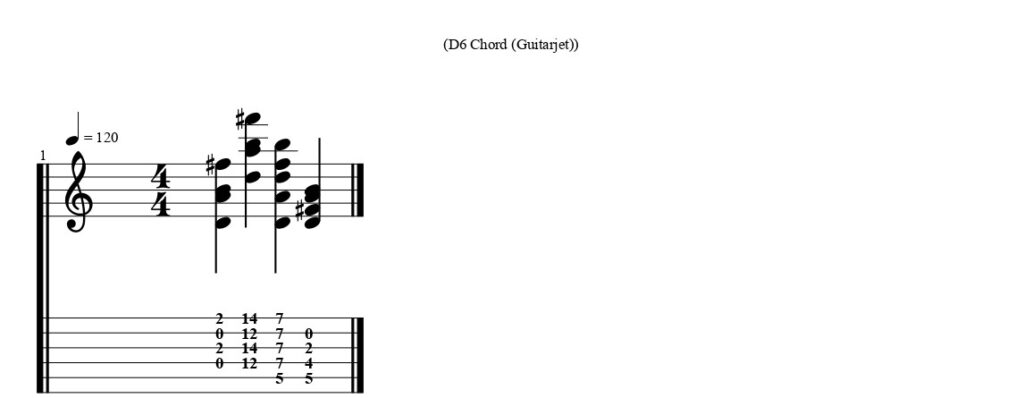
Shape 1: Open D6
The first shape is the open D6 chord. It’s like your normal open D chord, but you keep the B string open to add the major 6th.
Shape 2: D6 One Octave Up
The second shape feels just like shape 1, but you play it one octave higher on the same set of 4 strings.
Shape 3: D6 Barre Shape
The third shape is a standard D major barre chord with an added B note on the high E string to create the major 6th.
Shape 4: D6 From the A-String Root
The fourth shape uses a regular D major triad rooted on the A string, and the open B string rings out to give you the major 6th.
Audio
When to use the D6 guitar chord
The D6 chord is in the major chord family. This means you can use a d6 when you need:
- An alternative version of D major that sounds more hip and jazzy
- A substitute for Dmaj7 or Dmaj9
- A useful chord to transition to other chords like G, A, or Bmin.
Long story short, try using D6 as a substitute for any major chord with a D root note.
That’s It
Now you’ve learned what a D6 chord is on guitar and several ways to play it!
It’s a chord that sounds unique and great, and it’s surprisingly easy to play.

